

http://www.visiblemantra.org/labels/Tibetan.html
Om mani padme hum
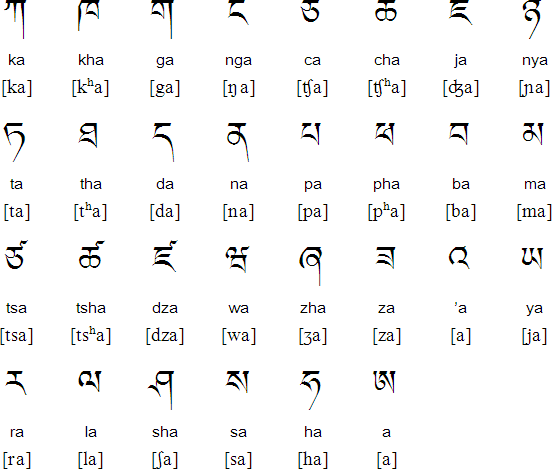
The Tibetan alphabet
The form of the alphabet shown below, known as u-chen (དབུ་ཅན་) is used for printing. Cursive versions of the alphabet, such as the gyuk yig or 'flowing script' (རྒྱུག་ཡིག་) are used for informal writing.
Consonants
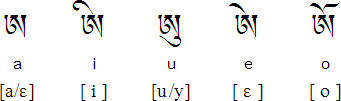
Vowels diacritics
Conjunct consonants

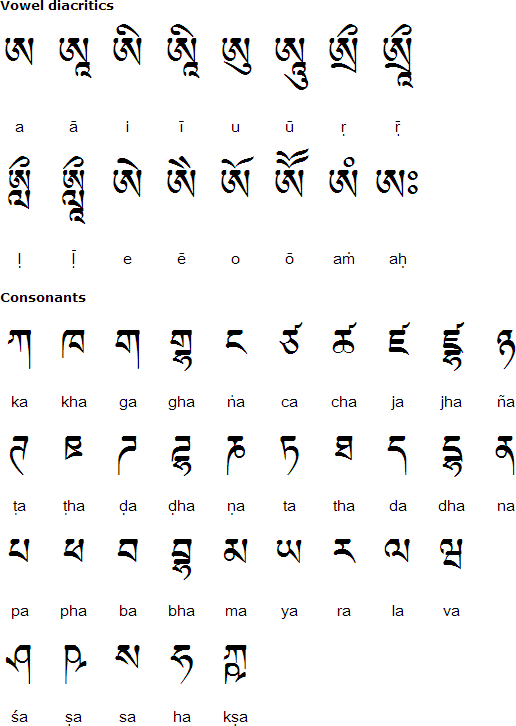
Tibetan script for Sanskrit
These are the Tibetan letters used to write Sanskrit. Some of them are not used in Tibetan.
http://www.omniglot.com/writing/tibetan.htm


http://www.ancientscripts.com/tibetan.html


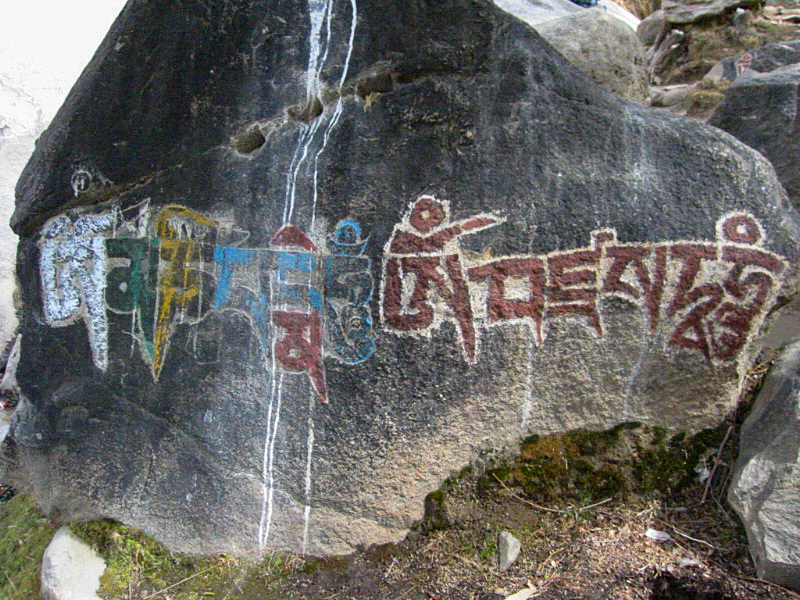

Oṃ maṇipadme hūṃ[1] (Sanskrit: ओं मणिपद्मे हूं, IPA: [õːː məɳipəd̪meː ɦũː]) is a mantra particularly associated with the four-armed Shadakshari form of Avalokiteshvara. Mani means the jewel and Padma-the lotus. It is the six syllabled mantra of the bodhisattva of compassion, Avalokiteshvara (Tibetan Chenrezig, Chinese Guanyin).
The mantra is especially revered by the devotees of the Dalai Lama, as he is said to be an incarnation of Chenrezig or Avalokiteshvara.
It is commonly carved onto rocks and written on paper which is inserted into prayer wheels, said to increase the mantra's effects.
Contents[hide] |
[edit] Transliterations

In English the mantra is variously transliterated, depending on the schools of Buddhism as well as individual teachers.
Most authorities consider maṇipadme to be one compound word rather than two simple words[citation needed]. Sanskrit writing does not have capital letters leaving capitalisation of transliterated mantras varying irrationally from all caps, to initial caps, to no caps. All caps is typical of older scholarly works, and in Tibetan Sadhana texts.
Possible spellings and their transliterations include:
- Tibetan: ༀམཎིཔདྨེཧཱུྃ། Om Mani Peme Hung or Om Mani Beh Meh Hung or Om mani padme hum (Ladakh)
- Devanagari: ओं मणि पद्मे हूँ; IAST: oṃ maṇipadme hūṃ
- Bengali: ওঁ মণিপদ্মে হুঁ
- Tamil: ஓம் மணி பத்மே ஹூம்
- Chinese 唵嘛呢叭咪吽, pinyin Ǎn mání bāmī hōng (due to changes over time in pronunciation, this transcription has been adopted in favor of the transliteration found in the Karandavyuha Sutra, 唵麼抳缽訥銘吽 Ǎn mání bōnàmíng hōng)
- Korean Hangul 옴 마니 파드메 훔 Om mani padeume hum or 옴 마니 반메 훔 Om mani banme hum
- Japanese Katakana オーン マニ パドメー フーン Ōn mani padomē hūn, オン マニ ペメ フン On mani peme hun
- Mongolian: Ум маани бадми хум or Um maani badmi khum
- Vietnamese: Úm ma ni bát ni hồng or Án ma ni bát mê hồng
- Thai: โอมฺ มณิ ปทฺเม หูมฺ
[edit] Meaning


Mantras may be interpreted by practitioners in many ways, or even as mere sequences of sound whose effects lie beyond strict meaning.
The middle part of the mantra, maṇipadme, is often interpreted as "jewel in the lotus," Sanskrit maṇí "jewel, gem, cintamani" and the locative of padma "lotus", but according to Donald Lopez it is much more likely that maṇipadme is in fact a vocative, not a locative, addressing a bodhisattva called maṇipadma, "Jewel-Lotus"- an alternate epithet of the bodhisattva Avalokitesvara.[2] It is preceded by the oṃ syllable and followed by the hūṃ syllable, both interjections without linguistic meaning.
Lopez also notes that the majority of Tibetan Buddhist texts have regarded the translation of the mantra as secondary, focusing instead on the correspondence of the six syllables of the mantra to various other groupings of six in the Buddhist tradition.[3] For example, in the Chenrezig Sadhana, Tsangsar Tulku Rinpoche expands upon the mantra's meaning, taking its six syllables to represent the purification of the six realms of existence:[4]
| Syllable | Six Pāramitās | Purifies | Samsaric realm | Colours | Symbol of the Deity | (Wish them) To be born in |
|---|---|---|---|---|---|---|
| Om | Generosity | Pride / Ego | Devas | White | Wisdom | Perfect Realm of Potala |
| Ma | Ethics | Jealousy / Lust for entertainment | Asuras | Green | Compassion | Perfect Realm of Potala |
| Ni | Patience | Passion / desire | Humans | Yellow | Body, speech, mind quality and activity |
Dewachen |
| Pad | Diligence | Ignorance / prejudice | Animals | Blue | Equanimity | the presence of Protector (Chenrezig) |
| Me | Renunciation | Poverty / possessiveness | Pretas (hungry ghosts) | Red | Bliss | Perfect Realm of Potala |
| Hum | Wisdom | Aggression / hatred | Naraka | Black | Quality of Compassion | the presence of the Lotus Throne (of Chenrezig) |
[edit] Karandavyuha Sutra definition
The first known description of the mantra appears in the Karandavyuha Sutra (Chinese: 佛說大乘莊嚴寶王經 (Taisho Tripitaka 1050) [5]; English: Buddha speaks Mahayana Sublime Treasure King Sutra), which is part of certain Mahayana canons such as the Tibetan. In this sutra, Shakyamuni Buddha states, "This is the most beneficial mantra. Even I made this aspiration to all the million Buddhas and subsequently received this teaching from Buddha Amitabha."[6]
[edit] H.H. the 14th Dalai Lama's definition
- "It is very good to recite the mantra Om mani padme hum, but while you are doing it, you should be thinking on its meaning, for the meaning of the six syllables is great and vast... The first, Om [...] symbolizes the practitioner's impure body, speech, and mind; it also symbolizes the pure exalted body, speech, and mind of a Buddha[...]"
- "The path is indicated by the next four syllables. Mani, meaning jewel, symbolizes the factors of method: (the) altruistic intention to become enlightened, compassion, and love.[...]"
- "The two syllables, padme, meaning lotus, symbolize wisdom[...]"
- "Purity must be achieved by an indivisible unity of method and wisdom, symbolized by the final syllable hum, which indicates indivisibility[...]"
- "Thus the six syllables, om mani padme hum, mean that in dependence on the practice of a path which is an indivisible union of method and wisdom, you can transform your impure body, speech, and mind into the pure exalted body, speech, and mind of a Buddha[...]"
[edit] Dilgo Khyentse Rinpoche's definition
- "The mantra Om Mani Päme Hum is easy to say yet quite powerful, because it contains the essence of the entire teaching. When you say the first syllable Om it is blessed to help you achieve perfection in the practice of generosity, Ma helps perfect the practice of pure ethics, and Ni helps achieve perfection in the practice of tolerance and patience. Pä, the fourth syllable, helps to achieve perfection of perseverance, Me helps achieve perfection in the practice of concentration, and the final sixth syllable Hum helps achieve perfection in the practice of wisdom.
- "So in this way recitation of the mantra helps achieve perfection in the six practices from generosity to wisdom. The path of these six perfections is the path walked by all the Buddhas of the three times. What could then be more meaningful than to say the mantra and accomplish the six perfections?"
[edit] Karma Thubten Trinley's definition
- "These are the six syllables which prevent rebirth into the six realms of cyclic existence. It translates literally as 'OM the jewel in the lotus HUM'. OM prevents rebirth in the god realm, MA prevents rebirth in the Asura (Titan) Realm, NI prevents rebirth in the Human realm, PA prevents rebirth in the Animal realm, ME prevents rebirth in the Hungry ghost realm, and HUM prevents rebirth in the Hell realm."
[edit] Variation


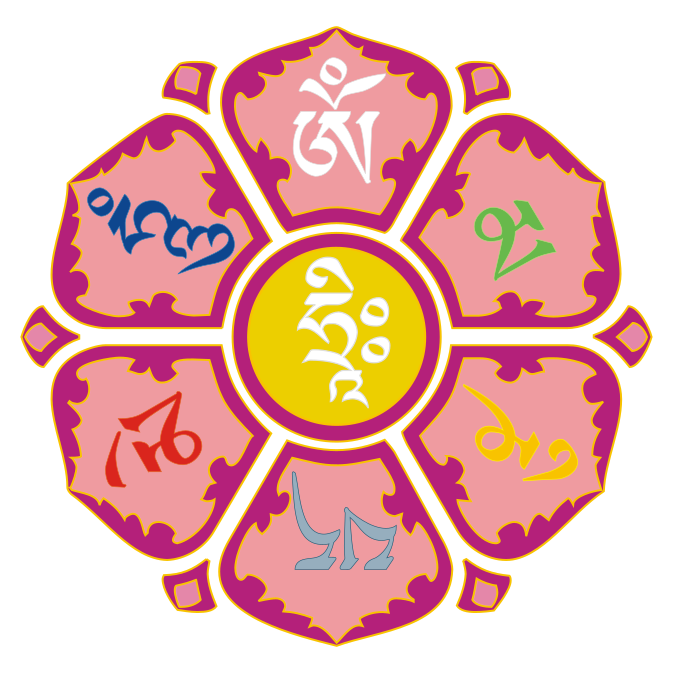
As Bucknell, et al. (1986: p. 15) opine, the complete Avalokiteshvara Mantra includes a final hrīḥ (Sanskrit: ह्रीः, IPA: [ɦriːh]), which is iconographically depicted in the central space of the syllabic mandala as seen in the ceiling decoration of the Potala Palace.[9] The hrīḥ is not always vocalized audibly, and may be resonated "internally" or "secretly" through intentionality.
[edit] Authentication
This mantra is also practiced nowadays (with a little incorrection) in the allegedly Naqshbandhi tariqa ruled by Arif Shah, Omar Ali Shah's son and heir. They say this mantra originated in Afghanistan.
As mentioned above, the mantra originated in the Karandavyuha Sutra in the Chinese Buddhist canon.[5] However, some other Buddhist scholars argue that the mantra as practiced in Tibetan Buddhism was based on the Sadhanamala published in the twelfth century.[10]
[edit] Music
- DharmaSound: Oṃ Maṇi Padme Hūṃ (see Buddhismo Ch'an/Zen and Buddhismo Vajrayāna)
- "Om Mani Padme Hum" by Snuffaluffagus
- "Strange Phenomena" by Kate Bush
- "Om Mani Peme Hung" by Dead Skeletons
- "Merry Christmas Mr. Lawrence - FYI" by Utada Hikaru
- Mani by Mantrasphere
[edit] Bibliography
- Teachings from the Mani retreat, Chenrezig Institute, December 2000 (2001) by Shramana Lama Zopa Rinpoche, ISBN 978-1891868108, Lama Yeshe Wisdom Archive downloadable
- Bucknell, Roderick & Stuart-Fox, Martin (1986). The Twilight Language: Explorations in Buddhist Meditation and Symbolism. Curzon Press: London. ISBN 0-312-82540-4
- Lopez, Donald (1998). Prisoners of Shangri-La: Tibetan Buddhism and the West. University of Chicago Press: Chicago. ISBN 0-226-49311-3.
- The phrase "Om mani padme Hum" also occurs in the song "Merry Christmas Mr. Lawrence - FYI" by Japanese-American singer Utada Hikaru, and in the song "Strange Phenomena" by English artist Kate Bush.
- "Under the Blanket" by Trevor Hall last lyric of the whole song.
- Used in the song "Inori ~Monlam~", by Akiko Shikata, whose lyrics are completely in ancient Tibetan.
- Mixed Martial Arts fighter Dan Hardy has Om mani padme hum tattooed on his stomach.
- This phrase is chanted in "Hunter and Moon Mysteries #6: The Starship file by Jen Moon, Hal's mother who is a quirky artist, during her meditation.
- The phrase "Om mani padme Hum" also sung by Jerry (John Spencer) in the opening scenes of WarGames (1983).
- The phrase "Om Mani Padme Hum" is chanted by the lead character, Joan Eunice Smith, and others during meditation in Robert Heinlein's "I Will Fear No Evil". (1970)
[edit] See also
- Shurangama Mantra – Expanded Protective Power of Om Mani Padma Hum
- Great Compassion Mantra – Expanded Compassion of Om Mani Padma Hum
- Buddhism
- Heart sutra
- Mantra
- Mani stone
- Samsara
- Ashtamangala
- Karandavyuha Sutra
[edit] Footnotes
- ^ Pronunciation of the mantra as chanted by a Tibetan refugee: Wave Format and Real Audio Format.
- ^ Lopez, 331; the vocative would have to be feminine
- ^ Lopez, 130
- ^ Tsangsar Tulku Rinpoche, Chenrezig sadhana
- ^ a b Studholme, Alexander (2002). The Origins of Om Manipadme Hum: A Study of the Karandavyuha Sutra. State University of New York Press. pp. 256. ISBN 0791453901.
- ^ Khandro.net: Mantras
- ^ Gyatso, Tenzin. Om Mani Padme Hum
- ^ Dilgo Khyentse Rinpoche, Heart Treasure of the Enlightened ones. ISBN 0-87773-493-3
- ^ Bucknell, Roderick & Stuart-Fox, Martin (1986). The Twilight Language: Explorations in Buddhist Meditation and Symbolism. Curzon Press: London. ISBN 0-312-82540-4, p.15
- ^ Li, Yu. "Analysis of the Six Syllable practice - the relationship between The Six Syllable and Amitabha". http://www.cqvip.com/QK/80443X/2003002/8922419.html. Retrieved September 1, 2008.
[edit] Further reading
- Alexander Studholme: The Origins of Om Manipadme Hum. Albany NY: State University of New York Press, 2002 ISBN 0-7914-5389-8 (incl. Table of Contents)
- Mark Unno: Shingon Refractions: Myōe and the Mantra of Light. Somerville MA, USA: Wisdom Publications, 2004 ISBN 0-86171-390-7
- Bucknell, Roderick & Stuart-Fox, Martin (1986). The Twilight Language: Explorations in Buddhist Meditation and Symbolism. Curzon Press: London. ISBN 0-312-82540-4
- A.H. Francke: The Meaning of Om Mani Padme-Hum, Journal of the Royal Asiatic Society, 1915
- Lama Anagarika Govinda: Foundations of Tibetan Mysticism, 1969. Samuel Weiser, Inc: NYC, NY. ISBN 0-87728-064-9.
- Rodger Kamenetz: The Jew in the Lotus (PLUS) with an afterword by the author. (HarperOne, 2007) non-fiction. Table of Contents
[edit] External links
 |
Wikimedia Commons has media related to: Om mani padme hum |
- Dharma Haven: Om Mani Padme Hum
- Khandro.net: Mantra
- Andrew West, An article on Om Mani Padme Hum in different scripts
- Buddha speaks Mahayana Sublime Treasure King Sutra English translation of Karandavyuha Sutra
- "Om Mani Padme Hum" Songs - collection 13 version of "Om Mani Padme Hum" songs (on 4 albums Mantra)

Cintamani
 |
This article has multiple issues. Please help improve it or discuss these issues on the talk page.
|


-late.14c.jpg)
Cintamani (Sanskrit; Devanagari: चिन्तामणि) also spelled as Chintamani (or the Chintamani Stone) is a wish-fulfilling jewel within both Hindu and Buddhist traditions.
In Buddhism it is held by the bodhisattvas, Avalokiteshvara and Ksitigarbha. It is also seen carried upon the back of the Lung ta (wind horse) which is depicted on Tibetan prayer flags. By reciting the Dharani of Cintamani, Buddhist tradition maintains that one attains the Wisdom of Buddha, able to understand the truth of the Buddha, and turn afflictions into Bodhi. It is said to allow one to see the Holy Retinue of Amitabha and assembly upon one's deathbed. In Tibetan Buddhist tradition The Chintamani is sometimes depicted as a luminous pearl and is in the possession of several of different forms of the Buddha.[1]
Within Hinduism it is connected with the gods, Vishnu and Ganesha. In Hindu tradition it is often depicted as a fabulous jewel in the possession of the Naga king or as on the forehead of the Makara.
Contents[hide] |
[edit] Nomenclature, orthography and etymology
- Cintamani (Sanskrit; Devanagari: चिन्तामणि)
- 'Wish-Fulfilling Gem' (Tibetan: ཡིད་བཞིན་ནོརྦུ; Wylie: yid bzhin norbu)[2]
The mani (jewel) is translated in Chinese ruyi or ruyizhu 如意珠 "as one wishes jewel" or ruyibaozhu 如意寶珠 "as one wishes precious jewel", and is pronounced in Japanese nyoi-hōju or nyoi-hōshu 如意宝珠.
[edit] History
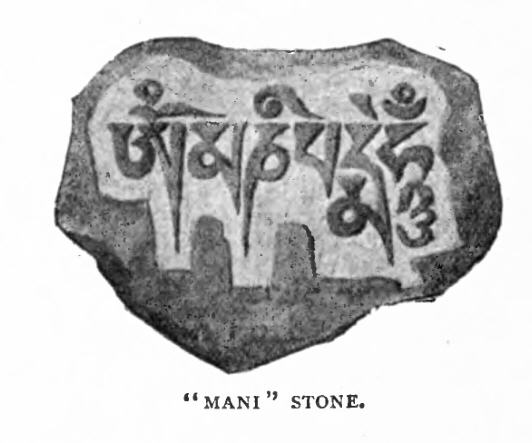

In Buddhism the Cintamani is said to be one of four relics that came in a chest that fell from the sky (many terma fell from the sky in caskets) during the reign of king Lha Thothori Nyantsen of Tibet.[citation needed] Though the king did not understand the purpose of the objects, he still kept them in a position of reverence. Several years later, two mysterious strangers appeared at the court of the king, explaining the four relics, which included the Buddha's bowl (possibly a Singing Bowl) and a Charmstone (jewel, crystal or gem) with the Om Mani Padme Hum mantra inscribed on it, known as a mani stone. These few objects were the bringers of the Dharma to Tibet.
The Digital Dictionary of Buddhism's ruyizhu entry says.
-
A maṇi-jewel; magical jewel, which manifests whatever one wishes for (Skt. maṇi, cintā-maṇi, cintāmaṇi-ratna). According to one's desires, treasures, clothing and food can be manifested, while sickness and suffering can be removed, water can be purified, etc. It is a metaphor for the teachings and virtues of the Buddha. … Said to be obtained from the dragon-king of the sea, or the head of the great fish, Makara, or the relics of a Buddha.
It has also been called an elixir that can fulfill wishes. Many treasure hunters have searched for this mystic of mystic gems. It is supposedly hidden in Shambhala (a magic forest and temple) that lies in the Hindu Kush.[citation needed]
[edit] Popular culture
The Cintamani Stone is the subject of Nathan Drake's second adventure in the 2009 video game Uncharted 2: Among Thieves.
[edit] See also
[edit] Notes
- ^ R. A. Donkin, Beyond price: pearls and pearl-fishing : origins to the Age of Discoveries, p.170 [1]
- ^ Scheidegger, Daniel (2009). 'The First Four Themes of Klong chen pa's Tsig don bcu gcig pa.' Achard, Jean-Luke (director) (2009). Revue d'Etudes Tibetaines. April 2009. Source: [2] (accessed: Saturday October 31, 2009), p.49
[edit] References
- Beer, Robert (1999). The Encyclopedia of Tibetan Symbols and Motifs (Hardcover). Shambhala. ISBN 157062416X, ISBN 978-1570624162
진각차문화협회 회원들이 이날 선보인 다례는 중앙(흰색 보)에 비로자나부처님, 동방(적색 보)에 아축불, 서방(청색 보)에 아미타불, 남방(황색 보)에 보생불, 북방(검은색 보)에 불공성취불의 다섯 부처님을 의미하는 자리를 마련해 팽주 오불이 등장한 후 중앙의 비로자나부처님을 중심으로 차를 우리며 네보살(지수화풍 사대)이 등장해 남(보생불)과 북(불공성취불) 두 부처님의 공양을 받아 분단의 갈등을 넘어 화합의 의미를, 동(아축불)과 서(아미타불)의 공양을 받아 지역의 갈등을 넘는 상생의 의미를 서로에게 전하며 동서남북 사불보살은 서로의 공양을 수행의 원력으로 세우고자 정성어린 차를 마시는 것으로 마무리했다. 이어 진각차문화협회 회원들은 월정사 경내에 마련된 코너에서 들차회를 마련해 불자와 관광객들에게 차와 떡을 공양했다.
http://www.milgyonews.net/news/news/photo_view.asp?idx=10484&msection=1&ssection=0
연화수보살(padmapani)
金剛은 대일여래(大日如來)의 金剛智를 뜻하고
이 金剛智에 加持하여 신행의 本尊인 37尊이 출생한다.
金剛은 범어로 vajra라하며,
이는 지상에서 가장 강한 광물이라는 특성 때문에
불괴(不壞)와 최파(催破)의 의미를 가지고 있는데
불괴는 진리의 영원성, 즉 법의 항존(恒存)을 뜻하고
최파는 일체의 불의(不義;마군, 외도, 미혹, 번뇌, 마장)를
쳐부수고 진리를 성취함을 의미한다.
또한 4색으로 나뉘어진 작은 금강과 흰색의 '옴‘자는 5불을 의미하는데,
적색은 동방 아축불,
황색은 남방 보생불,
청색은 서방 아미타불,
흑색은 북방 불공 성취불을 뜻하고
4불 위에 놓여진 흰색의 ’옴‘자는
중방 비로자나불을 뜻합니다.
이는 우주 법계를 뜻함과 五佛五智를 비롯한 일체 모든
밀교 교리를 총섭하는 밀교의 우주관을 나타내고 있습니다.
종단의 교주는 법신 비로자나 부처님이다.
비로자나 부처님은 시방 삼세 하나로 계시면서
온 우주에 충만하여 없는 곳이 없으며
가까이 곧 내 마음에서 나와 더불어 활동하고 계시므로
나의 입장에서 자성법신이라 한다.
비로자나 부처님은 항상 비밀한 가운데 무량한 법을 설하고 계신다.
이러한 비로자나 부처님의 자내증의 경지를
'옴마니반메훔'으로 나타내는데 이
'옴마니반메훔'을 육자진언 또는 육자대명왕진언 이라고 한다.
이 육자진언은 불 보살과 중생의 본심이다.
대중들은 보통 관세음보살의 본심으로만 이해하나 이는 얕은 해석이다.
종단에서는 이러한 '옴마니반메훔'을
신행의 중심 곧 본존으로 삼고 있다.
이 '옴마니반메훔'이 곧 교주 비로자나 부처님을 나타내고 ,
교주 비로자나 부처님이 곧 본존인 '옴마니반메훔'을 나타낸다.
왜냐하면 자신을 자성법신으로 삼고 우주에 충만해 있는
비로자나 부처님의 본심인
'옴마니반메훔'을 문자 본존으로 모셔서 자신의 본성과
우주의 진리가 항상 함께 상통하고 있기 때문이다.
옴마니반메훔은 보통
"오! 연화위의 마니주여"라고 하는 기원의 뜻미며,
라마신자가 부르는 주문으로 연화수보살(padmapani)께 귀의하여
극락에 왕생하기를 바라면서 부르면 죽은 후에 6도에 유전하는
제약을 벗어나는 공덕을 얻는다고 합니다.
또한 이 교도들은 연화수보살이 아미타불과 같아서
극락연대에서 기도하는 자를 구제하여 다음 생에 인과가 되는
무궁한 생사를 벗어나도록 함을 믿고 있으므로
승속을 불문하고 모두 입으로 부르며
마치 나무아미타불의 6자와 흡사합니다.
서장에는 관음경마니가보바(觀音經摩尼伽步婆)에
시로써 6자제목의 공덕을 찬탄하고
그 지혜. 해탈. 구제. 쾌락의 본원을 설하였습니다.
사람이 만일 6자 제목 가운데서
옴(om)의 자를 한 번 부르면 그 공덕이 능히 사후에
천상계의 길에 유전함을 막고,또한
마(ma)의 한 자를 부르면 악귀가 있는 수라도에 윤회함을 면하고,
니(ni)의 한자를 부를 때에 인간계에 태어남을 막고,
반(pad)의 한자를 부르면 사람이 축생의 위치에
윤회하는 어려움을 제거하며,
메(me)의 한자를 부르면 아귀도에 빠지는 고통을 벗어나며,
훔(hum)의 한 자를 부르면 죽어서 지옥에 떨어짐이 없는
공덕이 있게 된다 합니다.
또한
'옴'자는 천상계의 백색을 나타내고,
'마'자는 수라도의 청색이 되며,
'니'자는 인간계의 황색이 되고,
'반'자는 축생도의 녹색이 되며
'메'자는 아귀도의 홍색이 되며,
'훔'자는 지옥의 흑색이 된다고 합니다.
또한 유독 이 제목을 창하면 비로소 공덕이 있어 곧 몸에 붙으며,
혹은 손에 가지거나,
집에 저장하면 생사해탈의 길을 얻는다고 합니다.
서장인이 흔히 이 6자를 긴 천조각 등에 써서
책궤 속에 저장하고 法輪(법륜)이라 합니다.
http://junggaksa.com/xe/board6/26940
